|
|
|
 |
|
Welcome to
Astronomy Online
A legally blind photographer/astronomer on disability so I use this site to contribute to society.
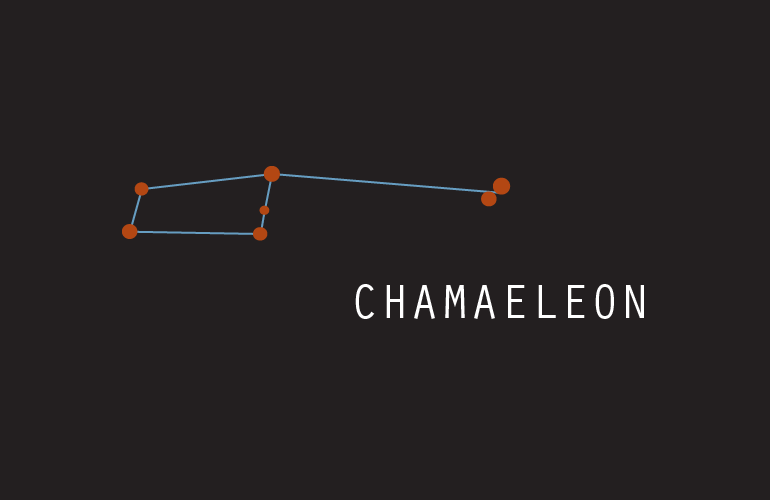
Last Updated: added graphics for the 88 constellations under Observation/The Night Sky.
This site is a testament that even though I have a physical disability - legally blind - I can still do things that helps other people.
Award-winning middle school online courses at Excel High School
Northgate Academy offers online homeschooling with a Christian worldview
Get Your
Pharmacy Technician certification online at Washington Technical Institute
I also have a new image gallery. I call it Second Site Image Gallery.
Check Grab My Essay which is one of the best essay writing services
Find on Top Writers Review your essay writing company
PickWriters provides the best translation services reviews
Find on LetsGradeIt best reviews on essay writing services
This is an educational website. It's never too late to learn astronomy, even for those who have not completed their primary (High School) education. A GED can get you in the door to college level courses.
|
Affordable academic writing company CheapWritingHelp.com provides students with unique astronomy research papers and science essays.
A-Writer essay writing service with the best PhD writers on Astronomy.
Stargazing to Star Charts: Engaging Students in the Wonders of Astronomy
|
|
APOD: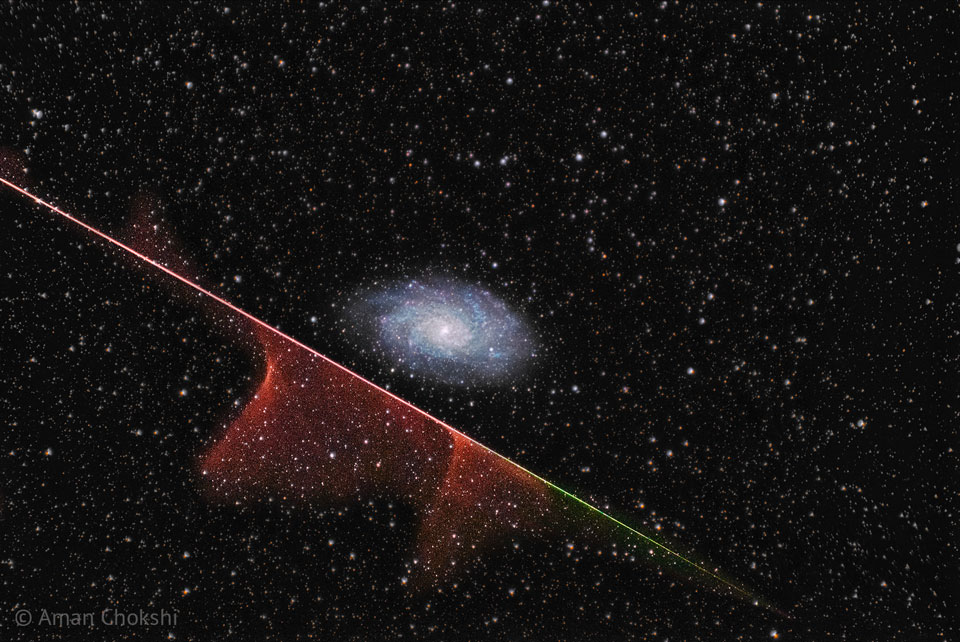 Meteor Misses Galaxy
Credit & Copyright: Aman Chokshi Meteor Misses Galaxy
Credit & Copyright: Aman Chokshi
Explanation: The galaxy was never in danger. For one thing, the Triangulum galaxy (M33), pictured, is much bigger than the tiny grain of rock at the head of the meteor. For another, the galaxy is much farther away -- in this instance 3 million light years as opposed to only about 0.0003 light seconds. Even so, the meteor's path took it angularly below the galaxy. Also the wind high in Earth's atmosphere blew the meteor's glowing evaporative molecule train away from the galaxy, in angular projection. Still, the astrophotographer was quite lucky to capture both a meteor and a galaxy in a single exposure -- which was subsequently added to two other images of M33 to bring up the spiral galaxy's colors. At the end, the meteor was gone in a second, but the galaxy will last billions of years.
|
Assignmentgeek.com – get professional assistance with astronomy assignments.
|
|
APOD: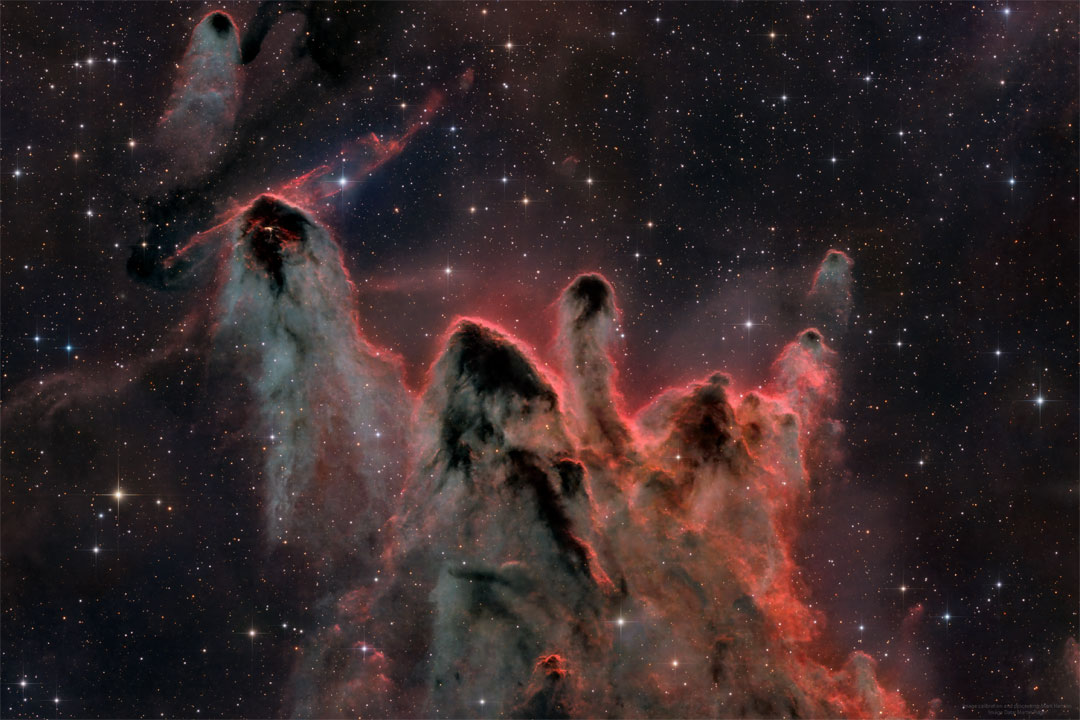 Cometary Globules Cometary Globules
Image Credit & Copyright: Mark Hanson & Martin Pugh, Observatorio El Sauce
Explanation: What are these unusual interstellar structures? Bright-rimmed, flowing shapes gather near the center of this rich starfield toward the borders of the nautical southern constellations Pupis and Vela. Composed of interstellar gas and dust, the grouping of light-year sized cometary globules is about 1300 light-years distant. Energetic ultraviolet light from nearby hot stars has molded the globules and ionized their bright rims. The globules also stream away from the Vela supernova remnant which may have influenced their swept-back shapes. Within them, cores of cold gas and dust are likely collapsing to form low mass stars, whose formation will ultimately cause the globules to disperse. In fact, cometary globule CG 30 (on the upper left) sports a small reddish glow near its head, a telltale sign of energetic jets from a star in the early stages of formation.
|
How to Get a Job at NASA After College
Cosmic Conversations: The Intersection of Language and Astronomy
How to Engage Students in Learning About Our Galaxy, the Milky Way: Virtual Tours, Stellar Maps, and More
|
|
APOD: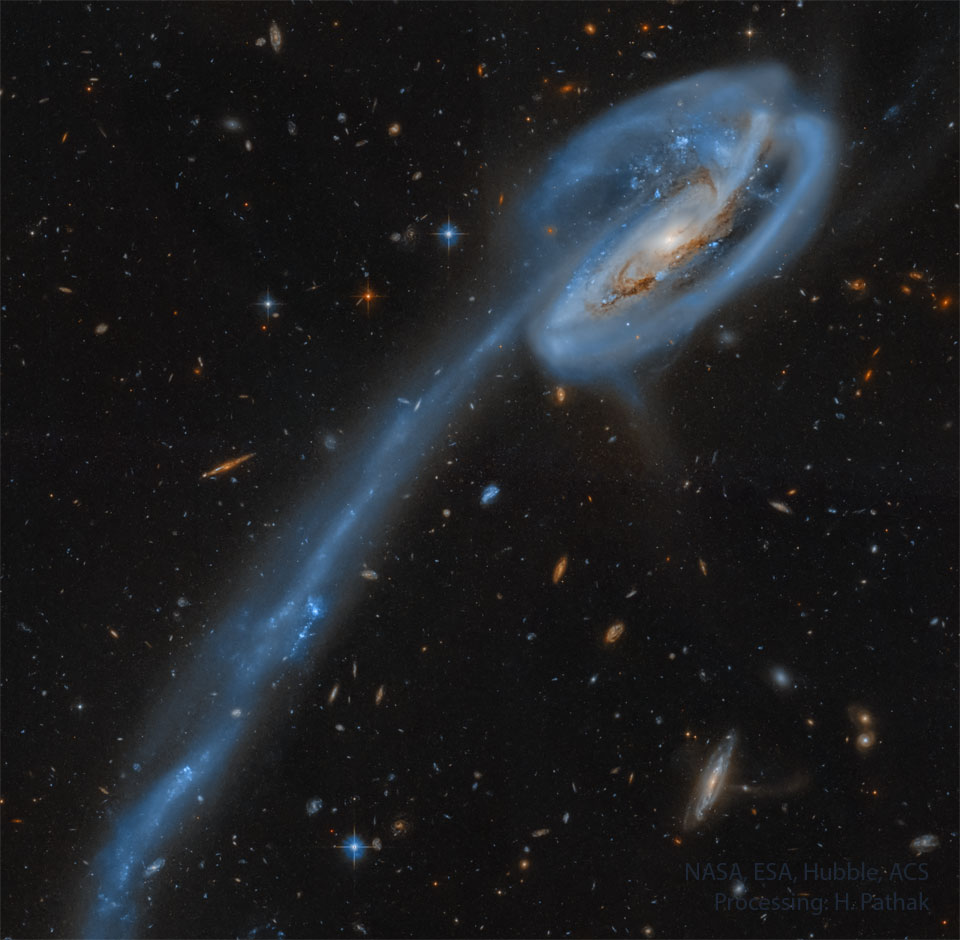 The Tadpole Galaxy from Hubble
Image Credit: Hubble Legacy Archive, ESA, NASA; Processing: Harshwardhan Pathak The Tadpole Galaxy from Hubble
Image Credit: Hubble Legacy Archive, ESA, NASA; Processing: Harshwardhan Pathak
Explanation: Why does this galaxy have such a long tail? In this stunning vista, based on image data from the Hubble Legacy Archive, distant galaxies form a dramatic backdrop for disrupted spiral galaxy Arp 188, the Tadpole Galaxy. The cosmic tadpole is a mere 420 million light-years distant toward the northern constellation of the Dragon (Draco). Its eye-catching tail is about 280 thousand light-years long and features massive, bright blue star clusters. One story goes that a more compact intruder galaxy crossed in front of Arp 188 - from right to left in this view - and was slung around behind the Tadpole by their gravitational attraction. During the close encounter, tidal forces drew out the spiral galaxy's stars, gas, and dust forming the spectacular tail. The intruder galaxy itself, estimated to lie about 300 thousand light-years behind the Tadpole, can be seen through foreground spiral arms at the upper right. Following its terrestrial namesake, the Tadpole Galaxy will likely lose its tail as it grows older, the tail's star clusters forming smaller satellites of the large spiral galaxy.
|
How the Website
is Organized:
Advertising within text will be in italics with a link to the ad source.
Observation - This section includes information on
coordinate systems, constellations, objects visible in the
night sky, and some images of the night sky of the
northern and southern hemispheres.
Science - This section includes information on some
of the basic science used in astronomy. There is information
on the variety of tools used (like telescopes) as well as
methods of using them. There is a mathematics primer,
introduction to some physical processes, formulas used in
astronomy, and information on computer use in Astronomy.
Solar System
- As indicated, this section covers our Solar System (See Solar System App, Solar System Scope App) and everything in it. It covers the Sun, planets, their moons, asteroids, comets and exotic objects like TNO's and Kuiper Belt Objects.
Stars - This section covers stars in our own galaxy.
It covers the variety of stellar evolution paths. It also
covers supernova, black holes, and some of the radiative
processes in the interstellar medium.
Our Galaxy
- This section covers our galaxy as well as some of the
nearby galaxies in our own Local Group. It also covers
galaxy evolution.
Cosmology
- This section covers other galaxies and galaxies clusters.
It also covers the big bang, relativity and dark matter.
Astrobiology
- This section covers the relatively new field in astronomy
- the possibility of life in our Solar System and the
Universe. There is also information on some of the projects
dealing with this - like SETI.
Exoplanets
- This section covers the study of planets known to exist
around other stars. It covers both amateur and professional
involvement and shows you how you can get involved with the
search as well.
Astrophotography -
This section covers the fastest growing hobby of
astrophotography. This section offers information and tips
on photography and also features and Image Gallery.
Back to Top
|
|






 English
 Farsi
Farsi